Caring for Yourself to Care for Someone Else: Why Occupational Balance Matters for Care Partners to PwPD
This blog is inspired by both my clinical experience as a specialist in occupational therapy and by the many conversations I have had with care partners through my research. Their stories have shaped my understanding of what it means to live alongside Parkinson's disease, not only affecting the life of the person with Parkinson, but also for the person walking beside them, the care partner.
When someone you care for is diagnosed with Parkinson's disease, life changes in ways you may never have expected.
In the beginning, you may simply offer a little more help with everyday tasks. Then, almost without noticing, you become responsible for medications, appointments, cooking, shopping, finances, and helping with dressing and mobility. You may find yourself constantly being alert, watching to prevent a fall. Your own plans become secondary because someone else's needs come first.
If this sounds familiar, you are far from alone.
Research shows that caring for a person with Parkinson's disease affects emotional, physical, social well-being, as well as the financial situation. As Parkinson's progresses and both motor and non-motor symptoms become more challenging, care partners often experience increasing levels of stress and caregiver burden. Yet, they experience, well-being and occupational balance receives surprisingly little attention.
There are several ways to define occupational balance. The definition I base my work on is defined as “the individual’s subjective perception of having the right mix (amount and variation) of activities in their activity pattern”
In other words, occupational balance is personal. Two people may have identical daily schedules, yet one feels fulfilled while the other feels overwhelmed. What matters is whether your everyday activities support your values, and quality of life.
For care partners, maintaining that balance can become increasingly difficult.
When "must-do" activities replace "want-to-do" activities
Some responsibilities, or “must-do” activities may be unavoidable, such as preparing meals, cleaning, managing medications, helping with personal care, attending appointments, and coordinating everyday life. And when everyday life starts to feel overwhelming, because a loved one needs our support, what is the first thing we let go of?
It is almost always the very things that restore us. The things that give us energy. The things that help us cope. And yet… those are exactly the things we need the most in a stressful daily life. The restorative “want-to-do” activities are in fact equally important, although they are often the first to disappear. These may include walking, reading, meeting friends, gardening, exercising, listening to music, enjoying hobbies, or simply sitting quietly with a cup of coffee.
As caregiving demands increase, the "must-do" activities gradually crowd out the activities that help us recover. This is occupational imbalance. The problem is not that caregiving becomes an important part of life. No. The problem is when caregiving becomes almost all of life.
We often care for ourselves last
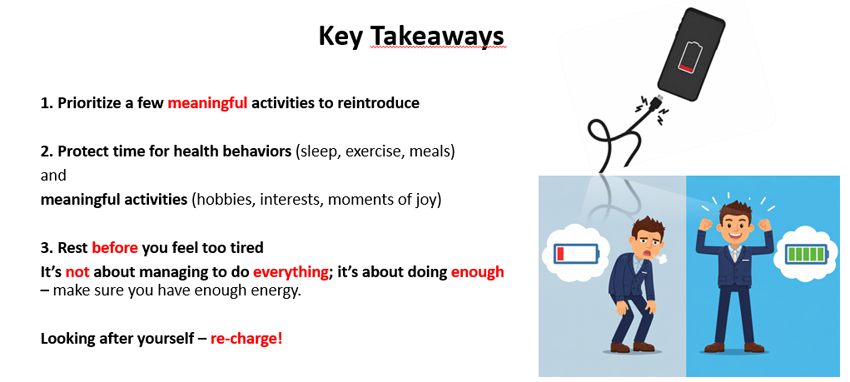
In fact, if we are honest, we often treat our mobile phones better than we treat ourselves. We would never let a phone battery drain completely before recharging it. We plan ahead. We plug it in. We make sure it has enough energy.
Yet many care partners do exactly the opposite with themselves. They continue giving their time, attention, and energy until they are completely drained, exhausted. They just keep on going. And going. And going… until there is nothing left.
What if we treated our own energy the same way we treat our phones? What if we allowed ourselves to pause—before we are completely drained? To plan breaks. To rest. To recharge.
Caring for yourself benefits both of you
Many care partners feel guilty when they spend time on themselves. However, taking care of your own health is not being selfish. It is essential for sustainable caregiving. In fact, maintaining your own well-being often improves your ability to provide support over the long term. For coping and managing the support and care your loved ones need.
As an occupational therapist, I often encourage people to ask themselves one simple question: "Am I helping because it is truly needed, or because it is faster if I do it myself?" Maintaining independence whenever possible benefits both the person living with Parkinson's disease and the care partner.
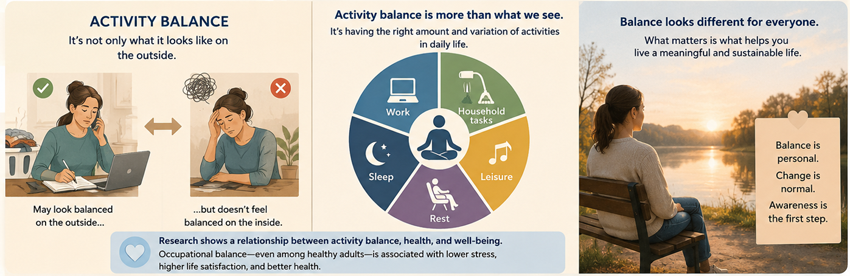
To help you find a better balance in life, I suggest three practical strategies that can make a meaningful difference. Occupational balance is not about creating the perfect schedule. It is about making intentional choices that protect your well-being while continuing to care for someone you love.
1. Bring back one meaningful activity.
Choose one activity that gives you joy, happiness or energy and make space for it again, even if only for a short time each week.
2. Protect the basics.
Sleep, regular meals, physical activity, and moments of rest are not luxuries. They are essential foundations for health and well-being.
3. Rest before you reach exhaustion.
It’s not about managing to do everything, it’s about doing enough, make sure you have enough energy. Looking after yourself – re-charge! Sharing responsibilities, connecting with other care partners, or consulting an occupational therapist can help you reorganize daily life before stress becomes overwhelming.
Looking after yourself is part of caring
Parkinson's disease is a journey that affects the whole family, not only the person receiving the diagnosis. Care partners deserve to be seen, listened to, and supported as individuals with their own needs, goals, and meaningful lives.
Looking after yourself is not a sign that you care less, it is absolutely quite the opposite. It is one of the most important ways to ensure that you can continue caring for many years ahead, while also preserving your own health, well-being, and quality of life.
Annicka Appelberg, PhD is currently a student in Caring Science, Faculty of Health Science, Kristianstad University, Sweden. She is also an OT specializing in activity and health in long-term disability. She presented a poster at the WPC 2026 on this topic which was part of the poster tour program. She also presented on this topic in the Care Partner Classroom & Lounge during the Congress.
Find her on Linked in at: Annicka Appelberg
Ideas and opinions expressed in this post reflect that of the author(s) solely. They do not necessarily reflect the opinions or positions of the World Parkinson Coalition®