Music, Dance, and Parkinson’s: Moving To The Beat
What a fabulous conference!
And such a colorful welcome from the hot hot hot city of Phoenix. People were super friendly, made a lot of effort to be helpful and inclusive, and it was a joy to see such diversity.
It’s not often you feel moved to laugh, cry, and be so inspired in such a short period of time, but WPC manages to deliver all that - and more. There was so much music, singing and dancing. It never ceases to amaze me how this can connect us all.
This was my second WPC, and I am still in awe of the incredible atmosphere that can created with so many people with Parkinson’s attending and making sure all the physicians, researchers and practitioners keep it real!

Music and Parkinson’s is my research subject and so I was delighted my poster was chosen to be part of the poster tour program. The research I presented was focussed on the movement intervention that we co-developed with people with Parkinson’s, practitioners and medical professionals in the UK and Switzerland.
Called Songlines for Parkinson’s, the idea is to help people with Parkinson’s develop a toolbox of music-based strategies to help with their movement and mood. We do this by exploring the soundtracks of peoples’ lives and music and dance from all around the world including dances like the Haka, which is a powerful ceremonial dance performed by the Māori people of New Zealand.
In our research, we found that:
- moving to music improved functional mobility (things like turning, getting up, and sitting down),
- people could use musical imagery to help overcome moments of freezing and regulate their walking,
- being able to choose their own music helped people with Parkinson’s have a sense of agency over their own treatment,
- sharing their music helped people with Parkinson’s feel more connected.
There was a lot of interest from researchers about how we had combined motion capture with a pressure sensitive gait mat to look in detail at the quality of movement, but also from practitioners about the co-development processes and people with Parkinson’s who wanted to learn how to run Songlines sessions in their own towns.
Post WPC, my plans are to work on some accessible training courses and to write a book to help people learn these strategies and integrate them into their everyday lives. Perhaps this will be what I share at the WPC 2029? Read more research about this field in some of these articles:
6. Playlist for Parkinson’s: a novel way to engage in music research dissemination

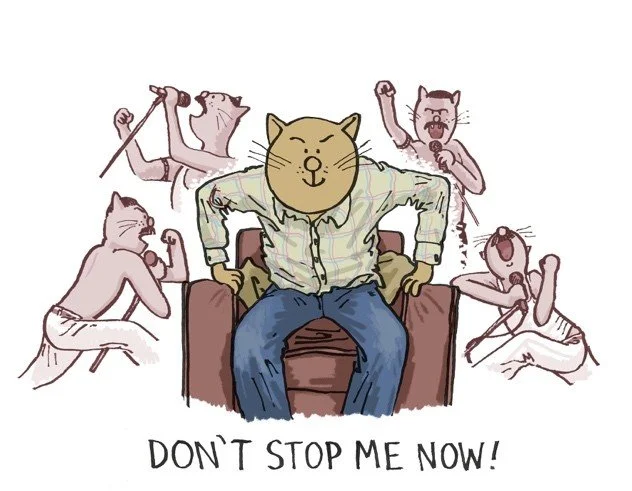
I was also excited to share a new resource: www.Playlist4Parkinsons.com where we have curated all the songs people with Parkinson’s have shared with us across a decade of research – and it’s still growing. Here we look at how people use music for motivation, for relaxation, for companionship, for distraction, and sometimes even have a personal anthem that has helped them get through their Parkinson’s diagnosis. We have been working with cartoon artist Jim Medway to bring these ideas to life. So many people mentioned the band Queen in our research, that a character named Freddie ‘the cat’ Mercury was born and in this image is demonstrating how a song such as ‘Don’t Stop me Now’ can be super motivating. Please feel free to visit and add your own musical tip, share a memory, or inspire others with your own personal anthem.
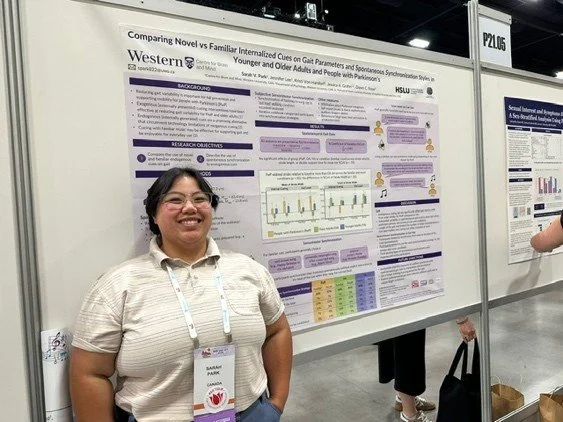
PhD Student Sarah Park presenting our research on types of musical imagery cues that can be used for Parkinson’s rehabilitation, WPC 2026.
Sarah Park also presented some exciting new research from the Brain and Mind Institute in Canada, exploring ways in which we can use musical imagery either from familiar songs, or teach new ones, to help with Parkinson’s rehabilitation. The use of musical imagery is an exciting prospect for Parkinson’s care, meaning we can use the music that’s already inside our minds and access it anywhere, anytime. Another of Jim’ s cartoons (shown above) demonstrates how we can develop our own internal jukebox of musical cues in this way.
We can’t wait for WPC in Québec City, 2029.
Dawn Rose, PhD, MSc is a Professor at Lucerne University of Applied Sciences and Arts in Lucerne, Switzerland. She attended and presented posters at WPC 2023 in Barcelona and at WPC 2026 in Phoenix. She is already looking forward to attending WPC 2029 in. Québec City.
Find her on LinkedIn at DawnRose
Ideas and opinions expressed in this post reflect that of the author(s) solely. They do not necessarily reflect the opinions or positions of the World Parkinson Coalition®