The King Of Causality Vs The Queen Of Microbiome
A patient’s perspective on why the science fails
There is a famous quote by W. Edwards Deming, often referred to as the Father of Quality Improvement, my profession before Parkinson’s;
“Every system is perfectly designed to get the result that it does.”
I will always think like a Healthcare Quality professional, it’s just how I’m wired. I analyze every system and think about breaking it down into a beautiful process diagram, all those squares and triangles, that were once my passion. The career I had before my diagnosis with Early Onset Parkinson’s. When I first became a person with Parkinson’s, a patient advocate, I thought I would be best suited to look at the health care system, hospital safety, the things I was already an expert on. I realized quickly I was overqualified and making no progress, so I moved on.
Life, my life at least, always seems to be driven largely by strange coincidences. One day, a friend, Benjamin Stecher, invited me to a Zoom meeting. Benjamin Stecher was a name I first saw on the cover of a book, “Brain Fables” which happens to be one of the first books about Parkinson’s I bought. A beautiful work that came from a partnership between a Neurologist specializing in Movement Disorders, Dr. Alberto Espay, and a person with young onset Parkinson’s disease, Ben.
I don’t know how I first connected with Ben, probably LinkedIn. I am more than just a Person with young onset Parkinson’s, I am a social media influencer, a digital storyteller. I share my journey with thousands of people all over the world. Which means I know a lot of people. The idea of a book written as a collaboration between doctor and patient appealed to me, and it didn’t disappoint. As a result, I decided to seek out the scientists, the Neurologists, the researchers, talk to them myself, like Ben did. So, I packed up my minivan, pulled my kids out of Middle School and asked my husband to chauffeur. We headed to Austin, it was 2023, less than 6 months after my diagnosis, to attend the Parkinson’s Study Group (PSG) conference. Why PSG? Conferences are expensive, but deep in the fine print of the PSG announcement was a mention that “advocates attend free”. That was music to my ears. I was an advocate, right? Sure, why not? It’s just a label, who is going to challenge me and my label? I felt like an imposter picking up my badge at the registration table, but it didn’t stop me and I quickly entered my first exciting session about cell therapy. I thought I would find a hot bed of ideas being exchanged, patients and doctors listening and learning, together, I was wrong. Instead, I was the only one, the only person with Parkinson’s in the room, a fly on the wall while researchers complained and said things like “patients should lower their expectations about side effects “. Lower our expectations!! I wanted to scream, but instead I took notes and went back home determined to do more. Which I did. Lots more, three years more.
Immediately after my diagnosis my husband told me he had talked to his niece, Haydeh, about me. Haydeh Payami, PhD, is arguably the Queen of the microbiome. The world’s leading expert on everything to do with the Parkinson’s gut. To our family she is Shabhnam, but to my husband she is still Shaboo. The energetic girl who danced and sang and was his childhood friend. What a crazy coincidence, we would say. I am a decade her Junior yet somehow her aunt. She was the first person to tell me how important diet and exercise were to my disease progression. As a Berkeley trained geneticist and the first person to use genome-wide association studies (GWAS) to identify the PD dysbiosis(1), I knew she wasn’t just whistling dixie. She had spent her life searching for the answers I now seek. We had already made plans to meet at an upcoming event, the 7th World Parkinson Congress.
Matthew Farrer, PhD, came into my orbit in an equally serendipitous way. On a Zoom call, twice actually, but we’ll get to that. I was listening to a talk by Dr. Alberto Espay, someone I admire and consider a friend, when it suddenly became half rigorous scientific debate half virtual alleyway mugging, between Espay, world renowned Parkinson’s researcher, Dr. Malu Tansey, WPC President, and some guy with a British accent who seemed quite sure of himself: Matthew “Matt” Farrer.
I asked Ben to connect me with Matt. Normally I would reach out directly, but Matt had almost no on-line footprint, just a LinkedIn account he never posted from, and a few YouTube recordings done by reputable charitable organizations. Turns out he was also a geneticist, had also dedicated his life to discovering the root cause of Parkinson’s and knew, had worked with, and respected Haydeh. Perfect match. Perfect timing. World Parkinson Congress, the triennial global conference for Parkinson’s that brings patients and care partners together with neurologists and neuroscientists was quickly approaching. Serendipity!
They both had new research, new papers working their way through review, lots of things to discuss. Surely Matt would be there, I would be there too! Just three years after my diagnosis I had been invited to speak, along with the MD’s and PhD’s I eventually befriended, what I had sought I had found. Matt wasn’t planning on going. He had his own problems and struggles, we all do. He wasn’t invited. Which seems, at first glance to be a problem of ego, but in reality is a problem of money. Something I realized was more of a factor since I was finally invited myself. I knew now how that felt, to be asked one year and not again. It always triggers that universal childhood trauma, the one born of not being asked to sit on a teeter totter or not getting invited to the birthday party. But more than anything it becomes a financial burden, especially for those that work.
Most researchers are also teachers, they divide their time between the duties of running a lab, administrative work, grant applications, teaching graduate students, and they get paid a shockingly low wage, for positions that require years of education. I don’t remember the exact moment the scientists started to become more human to me, but when that veil came off it led to my own recalibration. Everything I thought I knew was wrong. They scientists weren’t getting rich off us, their cheap shoes and cars told me that. They weren’t hiding a cure (they couldn’t even agree on the cause) and they weren’t indifferent to our suffering, they cared a lot. It’s hard to lay blame on people that you know don’t deserve it. Matt railed and raged against it all. Loudly, to anyone that would listen. I was listening. I was also talking, “if you’re so sure you’re right prove it! Go say it to their faces! That’s what WPC is all about.” I was frustrated; he was the third Parkinson’s expert that had informed me they were not planning on attending this year. I started to lump them all together in my mind, which wasn’t fair. People have lives, commitments, priorities, it’s just that WPC is so unique, an opportunity to connect on an equal playing field. Completely different than what I had been doing all this time, always meeting them from the audience, looking up. This time we would be on stage together. This time we would learn from each other.
It disappointed me that Matt couldn’t afford to go to WPC, but at least I would finally meet Haydeh, then another bump in the road, Haydeh broke her foot. She couldn’t travel, “Let’s have a zoom to catchup”, she said. It felt like a failure, a disappointing start to an event I had been looking forward to for three years. A zoom I thought, how poetic, that’s how I met Matt in the first place. I asked Matt to bomb our zoom, just like he had done Espay’s, except friendlier, he agreed. I thought it would take an edge off my disappointment of not finally meeting Haydeh if at least reconnecting the two of them after so many years, would still happen, just not in person. What happened when the surprise wore off, after everyone stopped laughing and telling a few stories, was what I had been longing to see, at every conference I went to, an honest exchange of ideas, with me, the person with the disease firmly in the middle. Suddenly that broken ankle was a lot less an obstacle to Haydeh than the task at hand. How to stop the progress of my disease.
Part Two
Mt Olympus vs Mt. Hara
It was Haydeh’s ultimatum, “I will come to WPC on my broken foot ONLY if you agree to sit down and listen and have something to help Esther?!” Everyone agreed, although it was really directed solely to Matt. There was a connection between them. Haydeh is older than Matt, wiser, she’s seen it all, but managed to maintain an infectious optimism that I suspect she was born with. Matt is pragmatic, says exactly what he thinks, yet somehow there’s a kindness about him. A frustrated patience I think geniuses probably develop over time. Together their intellect was overwhelming, but more importantly, they seemed to genuinely respect each other’s work and person. All the ingredients for a truly great experiment in Parkinson’s collaboration. Genetics, biochemistry, pathogens, microbiome, entire careers, decades of scientific knowledge and experience. Matt, thanks in no small part to the eponymous Eli Pollard, WPC Executive Director, had found a way to have his expenses covered and attend, she put him to work. Some things are just meant to be.
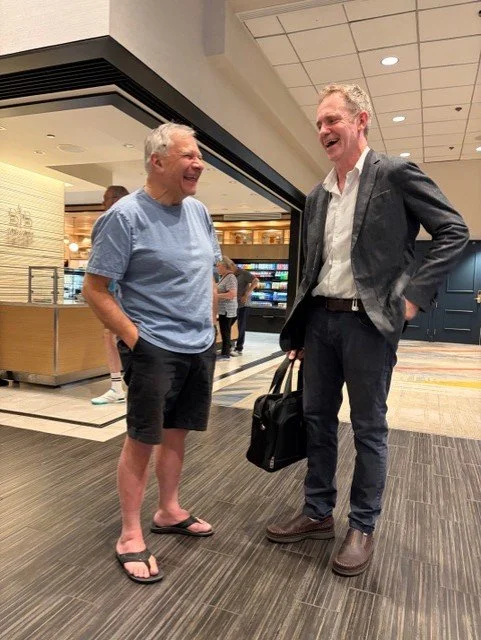
We were all at WPC the next WEEK! That’s how fast this happened. In the blink of an eye, we were all landing in Phoenix, joining a few of our 4000 closest friends, at WPC. After a good night sleep, I woke at the crack of dawn and went down to the hotel coffee shop to grab my kids some breakfast pastries, and ended up interrupting Matt having breakfast with Jon Stoessl, renowned expert in brain imaging, in flip flops. While waiting in line for breakfast, I turned around and realized the woman standing behind me in line was Haydeh! That is where we met, she had barely gotten her coffee, but we decided to push everything up. Which meant I missed all the first morning pre-conference sessions, which I never fully recovered from. On the empty second floor of the hotel conference level, around a square table and Haydeh’s poor leg propped up on a stool, I moderated my first scientific debate. Between geneticists, but so much more. It was marvelous. The equivalent of your first car ride being in a Formula one race car. They argued, but civilly, tinged with humor and mutual affection. One harshly critical, but wrapped in charm, the other one single of purpose and radiating positivity. I didn’t understand most of it: Scatter plots, SNIPS, SNCA, chitty chitty bang bang to my novice ears. I thought that this is never going to work, then it did. In under 2 hours they had agreed on a population, criteria, trial design, target, therapy, and possible grant funding. UNDER TWO HOURS. Everyone agreed, and Matt and I rushed to our duties in the conference, and Haydeh went back to her hotel room.
The conference felt like a blur. What had just happened? Did we just cure Parkinson’s? Of course not. But it felt like SOMETHING. Something inevitable, something REAL and tangible. As a person with a progressive Neurodegenerative disease with no real disease modifying therapy, it gets hard to watch the science articles roll out and the exciting headlines. Hard to reconcile the advances in science with the progression of my own symptoms. When you realize that each stage of a drugs approval is years, years you don’t have, you become impatient. It was after my second PSG in 2024 I realized this isn’t working. I mean it’s good, good work, good people, but I’ve seen more urgency in the opening of a bag of Doritos than I felt from anyone at that conference.
This, what had happened at that square hotel table, felt URGENT. Ok one thing you need to know about me is I am a very persistent person, annoying and determined, a lethal combination. I don’t give up easily. Turns out neither do Matt and Haydeh. The barriers are high, too many to share. But they will try, for all the right reasons, and if they can’t overcome them then we will know for certain something we already suspect. That the system doesn’t support the innovators, it doesn’t promote collaboration and shared data. That no matter if the cure came tomorrow, we may never even know about it because it would be just another study that didn’t get off the ground. So what is the point of it all? That people with the disease, the people that know it best, have a lot more power than we think. To support the science, to remind the researchers that we are the reason this work is being done. Our voices matter, we are also fundraisers, cheerleaders, and ultimately trial participants. We bring a sense of urgency to the work, because we mark time in the progression of the disease in our bodies, in the lives of those that love and care for us. Thank you to every scientist, for all your hard work, please hurry up.
(1) Dysbiosis: a medical condition caused by microbial imbalances within the body
Esther Labib-Kiyarash (USA) is a Parkinson’s advocate living with YOPD, a former hospital administrator, a mother of two young kids, a social media influencer (and a WPC 2026 Content Creator who also reported as part of the WPC From the Front Lines Reporting program. She presented as part of scientific program at WPC 2026. PM.
Find her online here: TikTok I Instagram I Facebook
Ideas and opinions expressed in this post reflect that of the author(s) solely. They do not necessarily reflect the opinions of the World Parkinson Coalition